Software vs Hardware GPS Spoofer: Which is Better for iOS in 2026? (Technical Deep Dive)
Complete technical comparison between software-based and hardware-based GPS spoofers for iOS. Learn why hardware spoofers are lower-risk and which approach suits your needs.
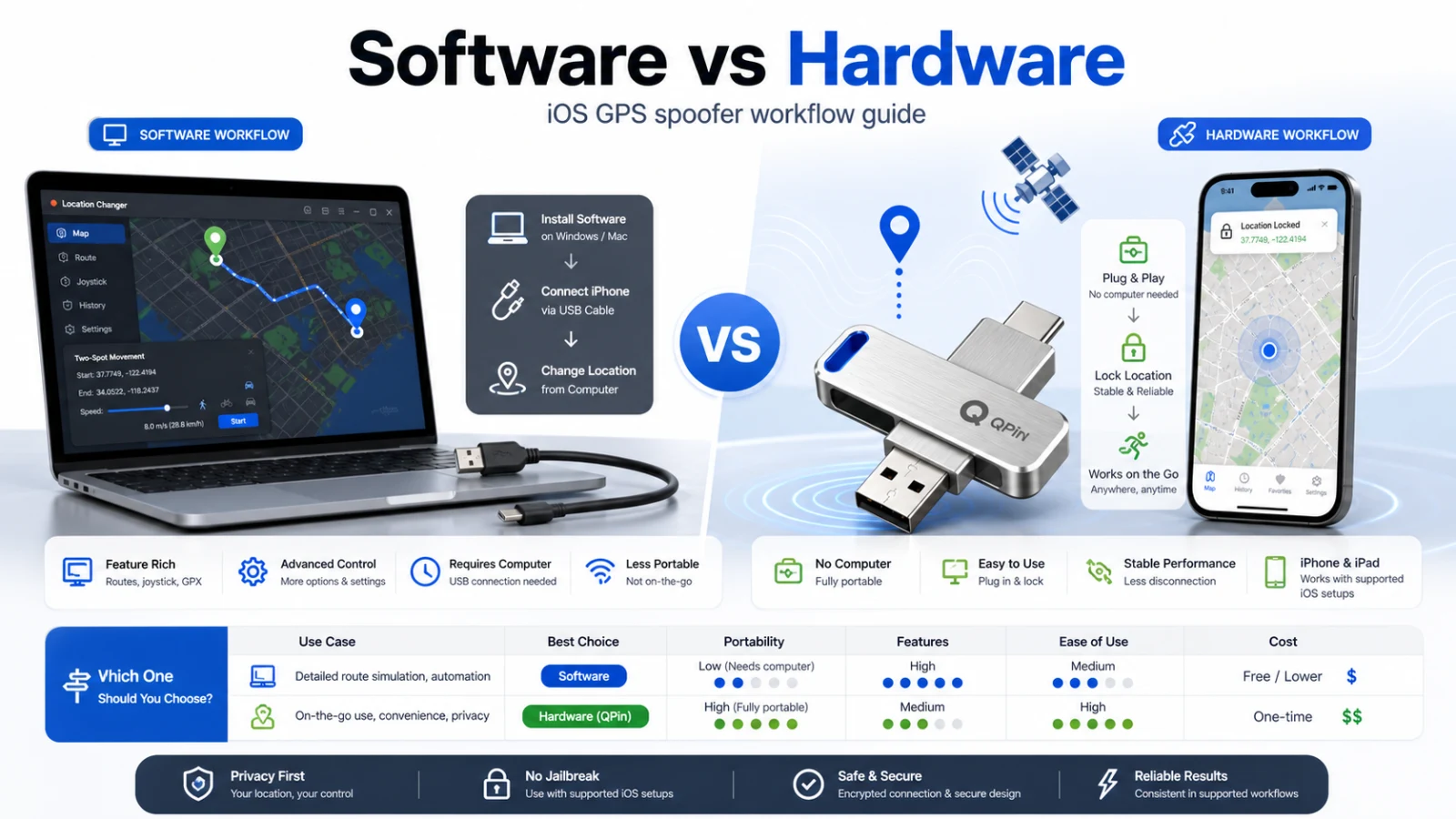
Understanding GPS Spoofing: Two Fundamental Approaches
GPS spoofing on iOS can be achieved through two fundamentally different approaches: software-based and hardware-based. Understanding the technical differences between these methods is crucial for choosing the right solution for your needs.
This guide provides a technical analysis of both approaches, explaining how they work at the system level, why software-side risk signals differ, and which approach fits different supported use cases.
Quick answer: software tools are easier to try and cheaper for one-off desktop testing. Hardware tools like QPin are better when you need portable iOS location control, fewer software-side signals, and a setup that does not depend on keeping a computer connected.
How iOS Location Services Work
Before diving into spoofing methods, let's understand how iOS determines your location:
iOS Location Stack
Location Data Sources
iOS uses multiple data sources to determine location:
The key insight: GPS is the most authoritative source. When GPS data is available, iOS prioritizes it over other methods.
Software-Based GPS Spoofing: How It Works
Software spoofers (like iAnyGo, Dr.Fone, AnyTo) intercept and modify location data at various points in the iOS location stack.
Technical Architecture
Methods Used by Software Spoofers
1. Developer Mode Simulation (iOS 17+)
How it works:
- Uses Apple's developer tools protocol
- Requires enabling "Developer Mode" in iOS settings
- Computer sends fake location coordinates via USB
- iOS Location Services receives simulated coordinates
Detection vectors:
- Developer Mode flag is visible to apps
- USB connection state can be detected
- Coordinate update patterns differ from real GPS
- No actual satellite data available
2. MDM/VPN Profile Injection
How it works:
- Installs a configuration profile on the device
- Creates a virtual network interface
- Routes location queries through the profile
- Returns spoofed coordinates
Detection vectors:
- Profile installation is visible
- System integrity checks can detect modifications
- Network-based location may conflict
3. Jailbreak-Based Hooks (Older iOS)
How it works:
- Modifies iOS system daemons
- Intercepts location requests at system level
- Returns fake coordinates to all apps
Detection vectors:
- Jailbreak detection is highly sophisticated
- System file modifications are detectable
- Security attestation fails
Software Spoofing: Detection Mechanisms
Modern apps employ multiple detection strategies:
1. Developer Mode Check
2. GPS Signal Analysis
3. Coordinate Pattern Analysis
4. Cross-Reference Checks
Hardware-Based GPS Spoofing: How It Works
Hardware spoofers (like QPin) operate at a fundamentally different level - they don't modify iOS at all. Instead, they provide GPS data as an external hardware accessory.
Technical Architecture
How QPin Works
1. Bluetooth External GPS Protocol
QPin communicates with iOS using the External Accessory Framework - the same protocol used by:
- Car navigation systems
- Professional GPS receivers
- Aviation GPS units
- Marine GPS devices
Why this is significant:
- iOS is designed to accept external GPS data
- No system modification required
- Treated as legitimate hardware
- Takes priority over internal GPS
2. NMEA GPS Data Format
QPin sends location data using standard NMEA 0183 sentences - the universal GPS data format:
These sentences include:
- Latitude and longitude
- UTC time
- Satellite count
- Fix quality
- Speed and heading
- Altitude
Key advantage: This is exactly what a real GPS receiver would send. iOS has no way to distinguish QPin from a legitimate external GPS.
3. System-Wide Location Override
When QPin is connected:
- iOS detects an external GPS accessory
- Location Services recognizes the Bluetooth GPS
- QPin's coordinates become the primary location source
- All apps receive QPin's location data
- Internal GPS is deprioritized
This happens at the hardware abstraction layer - below where any app or even most system services can inspect.
Hardware Spoofing: Why Detection is Nearly Impossible
1. No Software Fingerprints
2. Authentic GPS Characteristics
QPin generates GPS data with realistic properties:
- Satellite count: Reports multiple satellites
- Signal quality: Varies naturally
- Fix type: 3D fix with valid DOP values
- Time stamps: GPS time from atomic clocks
- Altitude data: Included and consistent
3. Movement Simulation
QPin's joystick and GPX features create realistic movement:
Software spoofers often produce:
Technical Comparison Table
Detection Risk Analysis
Software Spoofer Detection Rate
Based on community reports and testing:
Hardware Spoofer (QPin) Detection Rate
Use Case Recommendations
Choose Software Spoofing If:
- One-time development testing - Need to test an app once in a specific location
- Non-sensitive applications - Apps that don't check for spoofing
- Budget constraints - Need temporary solution for 1-2 months
- Always at computer - Never need mobile spoofing
Choose Hardware Spoofing (QPin) If:
- Pokemon GO - Anti-cheat is aggressive, hardware is essential
- Life360/Family tracking - Consistent, believable location needed
- Gig economy work - Need mobility and reliability
- Privacy protection - Want lower-risk location control
- Long-term use - One-time purchase, lifetime use
- Multiple devices - One device works with any iPhone
The Future of GPS Spoofing
iOS Security Trajectory
Apple continues to enhance location security:
- iOS 17: Added stricter developer mode requirements
- iOS 18: Enhanced GPS signal validation
- iOS 19+: Expected hardware attestation improvements
Impact on software spoofers: Each iOS update increases detection risk. Software solutions must constantly adapt, often with delays.
Impact on hardware spoofers: External GPS accessories are a legitimate use case (cars, aviation, marine). Apple cannot block them without breaking valid hardware.
App Detection Evolution
Apps are getting smarter:
- Machine learning for movement pattern analysis
- Multi-signal correlation (GPS + Wi-Fi + Cell + Bluetooth)
- Behavioral analytics for suspicious activity
Software spoofer outlook: Detection will continue to improve, making software solutions increasingly risky.
Hardware spoofer outlook: As long as external GPS accessories are supported (which is indefinite), hardware spoofing remains viable.
Conclusion: The Technical Verdict
The fundamental difference between software and hardware GPS spoofing comes down to where the spoofing occurs:
Software Spoofers: Working Against iOS
- Intercept at the system/application layer
- Create detectable fingerprints
- Fight against iOS security
- Require constant updates
- Have inherent detection vectors
Hardware Spoofers: Working With iOS
- Provide data at the hardware layer
- Use official protocols (External Accessory, NMEA)
- Leverage iOS's trust in external GPS
- Usually less dependent on desktop software patch cycles
- Minimal detection surface
For users who need portable, lower software-side signal exposure - whether for Pokemon GO, privacy, or testing purposes - hardware-based solutions like QPin are usually the stronger fit for supported iPhone/iPad setups.
The $150 investment in QPin provides: