Fix GPS Drift on iPhone for Gig Work: Physical GPS Spoofer Accessory
Fix iPhone GPS drift for gig work apps with QPin hardware testing. Set a known iOS location, compare maps, and document unstable GPS behavior.
How to Fix GPS Drift on iPhone for Gig Work Apps
Quick answer: fix GPS drift on iPhone for gig work apps should be treated as a GPS accuracy, risk, and compliance topic, not as a shortcut for live delivery work. Gig work apps are sensitive to small location errors because arrival, pickup, and handoff steps happen under time pressure. QPin Hardware can change the iPhone system location to a selected coordinate in supported setups, so owned-device GPS stability checks and controlled location tests are repeatable. Users should still follow the rules of the apps and platforms they use.
This guide is written for iPhone users in delivery, ride-hailing, QA, support, and privacy testing scenarios. It explains why iPhone GPS may show the wrong position, how to build a repeatable GPS drift test instead of guessing, and how to test location behavior without encouraging misuse.
Build a Drift Log Instead of Guessing
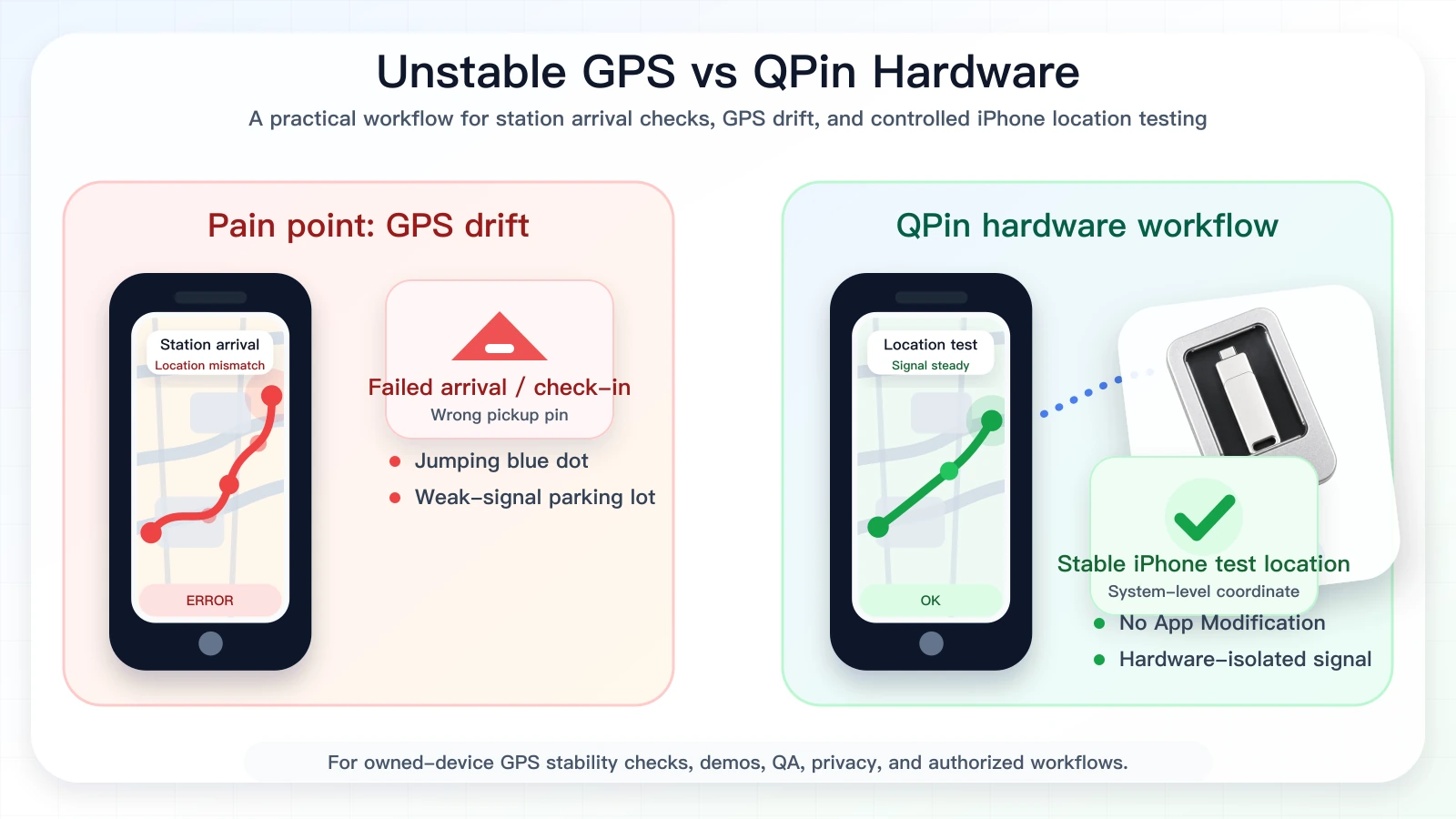
GPS drift is a time-series problem. A single screenshot can show the wrong dot, but it does not explain whether the phone drifted gradually, snapped to a stale Wi-Fi location, jumped after a cellular handoff, or only failed inside one parking structure. For gig work apps, the strongest troubleshooting evidence is a short drift log: exact address, app screen, Apple Maps screen, time, network state, battery mode, weather or indoor condition, and whether the issue repeats after a cold app restart.
QPin improves this workflow by giving you a known iPhone system coordinate for comparison. If the phone behaves normally at a controlled coordinate but drifts at a specific mall, store, warehouse, or curbside pickup area, the issue is likely environmental. If the same drift follows the phone everywhere, check iOS settings, app permissions, device hardware, or network state first.
Compliance note
QPin is not affiliated with DoorDash, Uber Eats, Amazon Flex, Spark Driver, Walmart, Uber, Lyft, or any delivery platform. Users should follow the rules of the apps and platforms they use. QPin is designed for owned-device testing, GPS stability checks, demos, privacy, QA, and authorized workflows.
This article does not provide instructions for evading DoorDash, Uber Eats, Amazon Flex, Spark Driver, Walmart, Uber, Lyft, or any platform checks. It does not promise marketplace advantages, queue outcomes, account outcomes, or universal compatibility with any delivery app.
Drift Testing Needs a Stable Reference Point
GPS drift is hard to diagnose when every screen is moving at the same time. For gig work apps, the fastest way to get clarity is to create a stable reference point: set a known coordinate, verify it in Apple Maps, then compare the target app from a fresh launch.
QPin is useful because it can set the iPhone system location to a selected coordinate in supported setups. If the phone stays stable in Apple Maps, you can stop blaming raw iPhone GPS and start looking at app cache, pickup pins, geofence timing, network state, or account workflow. If Apple Maps still jumps, the issue is deeper in the device or signal environment.
This turns a vague GPS drift complaint into a repeatable test that support, QA, or a driver can actually document.
Platform-specific risks and limitations
Even when the problem looks like simple GPS drift, iPhone GPS may evaluate more than the iOS location value. The app can compare your device position with pickup pins, route status, account state, sensor movement, and network context. A location error should therefore be handled as a troubleshooting and documentation problem, not as an invitation to force a different location.
If a workflow requires truthful physical presence, follow the platform workflow and contact support when the app is wrong. Keep screenshots of Apple Maps, the app screen, the address, and the time. Those records are more useful and safer than trying to work around the app.
Common causes of GPS drift or wrong location
For a broader checklist, start with iPhone GPS jumping or drifting fixes. If the issue is specifically a pickup pin, compare the process in Uber pickup location wrong on iPhone.
Safer testing workflow with QPin
Use QPin when you need to intentionally set an owned iPhone to a known coordinate, keep that coordinate stable, and compare what Apple Maps and delivery apps show. In supported setups, the hardware workflow changes the iPhone system location itself rather than patching one app, which makes it useful for reproducing GPS drift, wrong pickup pins, location jumping, and app-location mismatches.
A safer workflow looks like this:
- Confirm the problem first in Apple Maps and another map app.
- Check Location Services, Precise Location, Wi-Fi, Low Power Mode, and VPN status.
- Document the original behavior with screenshots and timestamps.
- Use QPin Desktop or the macOS/Windows setup guide to choose a test coordinate and apply it to the iPhone system location over USB, or use QPin Android when an Android phone is the USB controller.
- For portable controlled testing, review the QPin Hardware Manual.
- Return the iPhone to real GPS after the test and re-check the app.
After QPin changes the iPhone system location, apps that rely on iOS Location Services usually reflect the selected test coordinate. delivery apps can still apply its own account, network, sensor, timing, and policy checks, so use this only where you are allowed to test location behavior.
Troubleshooting checklist
- Turn Wi-Fi on, even if you do not join a network.
- Confirm Precise Location is enabled for the target app.
- Disable Low Power Mode during diagnosis.
- Compare Apple Maps, Google Maps, and the platform app.
- Take screenshots before contacting support.
- Do not use location tools to misrepresent active marketplace work.
If the issue repeats in one location only, record the address, parking area, store entrance, screenshots, time, and network state. If it repeats across many unrelated places, the iPhone settings, iOS version, app version, or device hardware may be more likely than a single bad map pin.
FAQ
Is fix GPS drift on iPhone for gig work apps safe?
It depends on the use case. Testing your own device in an authorized QA, privacy, demo, or support workflow is different from misrepresenting location during live delivery work. Follow platform rules and local laws.
Can QPin make iPhone GPS accept a selected test location?
No. QPin works with the iOS system location layer in supported setups, but iPhone GPS can apply its own account, network, sensor, geofence, and policy checks.
What should I do if the app is wrong while I am physically present?
First check iPhone settings, compare map apps, refresh the app, and collect screenshots with timestamps. If the platform workflow still fails, use official support rather than forcing a different location in verification screens.
When should I use QPin?
Use QPin when you are allowed to test location behavior on a device you own, need repeatable GPS stability checks, want a controlled demo, or need a QA workflow. Start from the QPin product overview or the delivery and ride-hailing GPS stability hub.
Related guides
- Best iPhone GPS stability tool for delivery and ride-hailing drivers
- QPin Desktop for Mac and Windows
- QPin macOS/Windows setup guide
- QPin Android setup guide
- QPin Hardware Manual
- iPhone GPS jumping or drifting fixes
FAQ
Can QPin replace platform rules or delivery app checks?
No. QPin is not a platform-override tool and should not be used to misrepresent location or evade platform rules. It is designed for owned-device testing, GPS stability checks, demos, privacy, QA, and authorized workflows.
Why does iPhone GPS show the wrong location on iPhone?
Common causes include weak GNSS signal, indoor pickup areas, stale Wi-Fi or cell assistance data, disabled Precise Location, map pin errors, VPN or network mismatches, and app-side risk controls.
What is a safer way to test iPhone location behavior?
Use a phone you own, test only where you are allowed, record before-and-after evidence, compare Apple Maps with the target app, and avoid live workflows that depend on truthful physical presence.
Does Precise Location fix every delivery app GPS issue?
No. Precise Location is important, but delivery apps may also use map data, account state, network signals, sensor movement, geofences, and policy checks.